Showing posts with label cyclo-touring. Show all posts

Wednesday, May 8, 2019

Experiencing the Geographical Majesty and Hospitality of Nepal


Born and raised in the Sonoran Desert of Tucson, Arizona Elliot Dumont loves traveling by bike. His trips include the Arizona Trail, Continental Divide, Colorado Trail, Mongolia, Nepal, and Baja among many others. Cycling has always been a staple in his life,  since since middle school and it is where he finds himself to be the most comfortable. For this trip Elliot wanted to take a different turn and focus on not just on riding, but explore the cultural aspects of our changing world and using a bicycle for a vehicle of connection with the people and the landscape. I love my Soma Juice 29er and feel it was the best choice for any international trip.

Words and Photos: Elliot Dumont, Roadrunner Bicycles

Flying into Katmandu I was struck with the thought that maybe I had bitten off more than I could chew. These were really big mountains. And these weren’t even the big ones. The mountains that surround the Kathmandu valley rise sharply as does the rest of the country. Nepal is about the size of Tennessee with its lowest point being about 1000 feet above sea level and then the land literally skyrockets upward to the height of Everest at 30,000 feet. My plan to ride back roads from Kathmandu to the Annapurna circuit, then around the circuit and find a bus back to Kathmandu alone and self supported suddenly seemed figuratively and literally much more daunting than I had thought.The airport was full of adventure-seeking tourists and business people as well as local Nepali. Outside the street was full of hired drivers with signs with a lot of yelling in Nepali for taxi cabs. The dust from the dirt road rose as cars passed by in the thick humid air. The heat of the sun was penetrating. The monsoons were nearing a close and though rainstorms were frequent, the sun had dried the roads. The ever growing population and traffic made the air quality in Kathmandu pretty poor. Traveling through the streets packed with people, the life of the city ebbed and flowed around the narrow streets and along the stalls selling tea, dahl baht, all sorts of steamed and fried goods, clothing, tailor services, kitchen equipment, and motorcycle shops.I pulled into the hotel unloaded my bike box, checked into my room, dropped off my luggage and quickly assembled my Soma Juice 29er. It was my vehicle of choice for this adventure. A sturdy frame that was a great ride when I rode across Mongolia. It had the dependable handling and comfortable feel I wanted knowing I would be navigating some pretty gnarly descents and spending very long days in the saddle. A few days prepping in Kathmandu and I was off.


The monsoons had dumped their last bits of rain as I had made my final preparations to leave Kathmandu and the roads were not dry yet. I left the city behind as I climbed into the clouds along the main road that headed north. The road turned to dirt and soon mud. The sedimentary rock that comprises most of the lower Himalaya create a soupy mud like mixture when wet that is great for farming but poor for roads and draining. The roads when wet can be nearly a foot deep of mud and nearly impassible if only by a large truck or tractor. Somehow buses and all sorts of other vehicles find their way along these windy and dangerous mountain roads. I was glad I was on a larger tired 29er bike that could torque through the mud better than a gravel or touring bike.
The hillsides in Nepal are an impressive feat. The people in Nepal have found a way to eek out a living on the steepest terrain. The climbs meandered for miles gaining thousands of feet of elevation before plummeting in a similar fashion down into the next river valley. These large geographic barriers have led to Nepal being an incredibly diverse place with over 100 ethnic groups and nearly as many languages. Due to the rain and the steepness of the terrain, it took me an extra day and a few diversions to get to the start of the circuit. One delay led me to stay at a family’s house. It was getting dark and I knew I wouldn’t make it to the town I wanted to. The sun was setting. I had asked about the location of campsites as I passed through a town earlier. I was instructed to just go to a tea house. I had no idea what a tea house in the countryside looked like. I found this family sitting on their front porch. I pulled over. Put my hands by my head as if I was mimicking sleeping and said, “Tsea?” (Tea) and pointed to their house. They paused for a second and then waved me over. That evening we chatted as they made dinner. Their grandson was staying with them and he translated for us. They let me stay the night with them and in the morning we ate breakfast together. I paid them what I thought was a fair price and they agreed. It was an amazing experience to be able to connect with total strangers and be in awe of their hospitality. 


Entering the circuit I was struck by how different the towns were from those in more rural areas. The abundance of hotels and amenities like wifi and western food was reminiscent of home and a sign of how these towns had transitioned to a tourist economy. The road along the circuit was in fairly good shape although landslides were an ever present danger. During the monsoons, the landslide danger grows exponentially with one villager telling me about a village across the valley that was nearly wiped out from a large landslide. The road would sometimes be covered by a landslide and I had to choose between picking my way across the steep debris field carefully or backtrack and ride/carry my bike along the trekking path. Moving further up the circuit, the mountains of the Annapurna range came into view. They were impossible to look at without craning ones neck upwards. They were huge.
The religious mix of Nepal is spread between 80% Hindu, 10-15% Buddhist and the remaining 5% split between ethnic religions and Christianity. These religions are commonly split up along altitude. Ethnic groups that inhabit higher elevations are more likely to be Buddhist and those lower down especially along the border with India are Hindu. It was evident as I climbed along the circuit to witness the change in morning rituals and through conversations with people. The route climbed up to Thorong La pass at around 18,000 feet. Definitely the hardest hike a bike I have ever done. Leaving before daylight, I had strapped my bike and all of my gear to my back, around 80 lbs all together. I slowly made my way through the darkness. The stars were out and the faint moonlight illuminated the distance snow covered peaks. The temperature was pretty chilly, my CamelBak I had rested on my chest pack was starting to freeze over. The sun came out and that warmed the air a bit, but the wind picked up and sucked any warmth away. Due to the weight of my pack and the altitude, I could not walk far or fast. It was slow going. I would take ten to fifteen steps then rest on my hiking poles. After 5 hours and 2,500 feet of ascending, I reached the summit. It was delightful. The descent was amazing and it burned through a pair of brake pads. It descends some ridiculous amount of feet in a very short distance. There has been nothing like it I have ever ridden.

"The descent was amazing and it burned through a pair of brake pads."


I descended into the lower Mustang region. Upper Mustang, further up the river valley, is the most remote area of Nepal. It has been deemed by the government, in the name of cultural preservation, a protected area that requires a guide and a steep entrance fee to be able to explore that area. I descended through the holy area of Muktinath and further down the valley towards the rain forest below towards Pokhara. The dry arid desert slowly turned to pine forests and then dense jungle. I was blown away by how the descents kept going and going. When I thought I had descended all that I could I would come a vista and see yet thousands more feet I would descend to the next town. I ended the biking portion of the trip in Pokhara before spending a day before taking a bus back to the bustling and chaotic streets of Kathmandu.
It was an incredible and rich experience. I was fortunate enough to speak to many different types of people from all different walks of Nepali life. I found out just how little I knew about Nepal. In the day and age of adventure and the freedom by which we throw that word around little attention is paid to the people, places, and history where these adventures take place. I would like to thank Soma Fabrications for their support and help to get me along this journey and empowering me to be able to research and write a book about this adventurous place and its people. Thank you also to Stan’s No Tubes, Thompson Components, and all of the people that contributed to my Kickstarter. Thank you to my family and my girlfriend for their love and support. 


Friday, June 8, 2018

Cape to Kapp: Rough roads and Lion Tracks in Tanzania

Teresie Hommersand grew up near Stavanger, a city known as the oil capital of Norway. She 
remembers eating supper every evening off plates with the logo of the national oil and gas company on them. Somehow she became the "green sheep" of the family. She has lived in Uganda, Oregon, and Australia. Learn more about her 13,700 km ride going from South Africa to Norway and her charity crowdfunding campaign on her Facebook page and Instagram.
(This is her fifth journal entry for us)


The route I end up taking across the continent on my Soma Saga is a result of the rough plan I made before I started cycling and information I gott along the way, often from random people I meet. Tanzania was meant to be one of two countries in Africa were I would just cycle through. There were no places that I wanted to explore that I had not been before. The plan was to take the shortest route to Nairobi. That would have been along one of the country's most heavily trafficked roads. There are no lack of fatal accidents here. Friends of mine have come across cyclists on this stretch that have been unlucky. I got word of another route, a route a bit further west. Apparently, the traffic was significantly less here and the scenery was stunning. BUT most of this stretch was not paved. After having done the first kilometer on this dirt road one late afternoon, I seriously wondered what in the world I had embarked on. Was it too late to turn around? That night, there was heavy thunder and lightning.


Adjustments and New Challenges
The following day can be summarised in the following words; gravel, sand, rocks, washboard, and bump after bump. My bike and panniers have never been shaken or rattled as much and on a couple of occasions, involuntary words and sounds escaped my mouth in pure frustration and anger. Yes, it is possible to get angry at a road. There was nothing to do but adjust my mindset! No way I was gonna be able to do 100km in a day. Maximum 50. After accepting that the next 400km were going to take me twice as much time and require double the amount of work (at least), I felt better. Besides, that evening I got other things to think about when my random host for the night told me that up ahead was a stretch with lions. How much fun! What is a bumpy road in light of this? That night, I was served ugali (East Africa's "potato" - a stiff maize flour dough) and buffalo meat! The buffalo was killed with a spear, I was told! A few days later when I camped in the compound of a park ranger that was part of an anti-poaching squad, I learned that that buffalo was most likely illegally hunted. Everyone, regardless of nationality, must have a permit to kill game in Tanzania. It is very interesting given that traditionally, many ethnic groups in Tanzania have made a living by hunting game, and some still depend on doing it today to make things go around. That evening I was also served a cup of cow milk-- as fresh as it gets-- straight from the cow. It warmed my hands when I wrapped them around the plastic cup.

 Breakfast! Chapati and chai. This lady gave me some extra maandazi (similiar to a donut, just not as sweet) for the road.


Lion Country
Over the next couple of days of cycling I tried to find out more about the 'lion situation'. I received so much conflicting information! Some looked appalled when I told them I considered cycling through this area alone while others said hakuna matata! No problem! 
When there is so much uncertainty, how can one make the right choice? Should I get an escort? Or just cycle? Jump on a bus even though I really want to cycle the whole day...? At one stage I cried with the thought of encountering a lion. It's a terrible feeling, being afraid to die. To be eaten by a lion.

When I reached where lion territory presumably started I was still not sure what to do. The plan was to make some final inquires in the last village that bordered this area. I cycled past a few houses. Thought this can't be the village, so I continued. Soon, it was just me and the red coloured dirt road again. Trees on both sides and silence. No people. And there... in the middle of the road I suddenly discovered lion tracks. As if a button had been pushed, my heart started racing. The adrenaline pumped through my body like there was no day tomorrow. All my senses were heightened, alert and ready. I got off the bike. I've been told to NEVER run from a lion. You must look her or him in the eyes, make yourself big (have I not mentioned that I'm quite small?), make loud sounds. Make the lion believe that you are bigger and stronger - even though fear is seaping out of your every pore. I could see that the tracks were not super fresh, but it doesn't matter. You are still terrified. TERRIFIED. I had my back against the bike, scanned the terrain. Every bush, every stump. Every rock. 360 degrees, non-stop, searching for a lion. I had my pepperspray hanging around my neck. My knife easily accessible. The DIY flamethrower in my hands - a tip from another cyclist. Lions are afraid of fire.

Who knows how long I stood like this. I didn't see a living creature. No cars or motorcycles that  I could cycle along with. I could not stand like this forever. 

What should I do? Cycle back to the houses I had passed? Keep on going to the next village?

 I ended up turning around. It was three kilometers of backtracking vs 13km to the next civilization. I felt a huge sense of relief when I spotted the houses again. I felt even better when I found a guy who was willing to come with me through 'the lion stretch'. He escorted me with his machete on his hip, a torch and umbrella on the back of his bike and complained that I cycled too fast. No lions. Only monkeys. Who knows, maybe it would have been fine without an escort? Perhaps I could have saved that expense? At the end of the day, it was actually really nice with some company.  
My escort thru lion country.


Welcome to Tanzania! Crossing the border.


Rhythm

Tanzania turned out very differently than planned. It was here I felt that I really got into the rhythm of bicycle touring, no doubt due to the route I ended up taking. The typical African dirt road. The colours. Thunder. Afternoon showers. The warmth and hospitality I was met with after a day's cycle. The best chai (tea). Chapati. Beans. All the rattling. The dust. The lions. The strive on the rough road. The tears. Perhaps all the hardships made the times were everything was flowing freely, the road was smooth (kind of) and fun to ride, the meetings with people were sincere and rewarding even better?
Nothing beats surfing on top of wet sand in the middle of the road, avoiding the streams of water on both sides right after a rain shower. The air and smells are so fresh! The sky so blue. Yellow butterflies fly infront of my wheel like dolphins swim and jump infront of moving boats. I'm smiling. Am happy. Free. Have a sence of achievement. Soon enough the heat will return and the tsetse flies will start biting again... so just enjoy;-)

Wednesday, November 22, 2017

Cape to Kapp: Notes from a Very Tired Cyclist

Teresie Hommersand grew up near Stavanger, a city known as the oil capital of Norway. She remembers eating supper every evening off plates with the logo of the national oil and gas company on them. Somehow she became the "green sheep" of the family. She has lived in Uganda, Oregon, and Australia. She currently resides in South Africa.  Learn more about her 13,700 km ride going from South Africa to Norway and her charity crowdfunding campaign on her Facebook page and Instagram.
(This is her third journal entry for us)


Powering through Zambia is rough. It's one hill after the other. Extremely hot. Often windy and always blowing from the front. I was doing 100km each day on my Soma Saga weighing in about 45kg with all my gear. Although physically challenging, it was the kids that got to me...


Typically, I would be coming up a hill, super tired and out of breath. Then the Mzungu (white person) alarm would go off. A kid would spot me and start screaming this word, "my favourite", over and over again from the top of his or her lungs - letting everyone in the whole village know who had just arrived. Kids would then come running from all sides, some sounding like they were having a fit when they saw me, joining the --by this point-- horde of kids screaming on repeat: 'HOW ARE YOU? HOW ARE YOU? HOW ARE YOU? HOW ARE YOU? HOW ARE YOU? HOW ARE YOU? HOW ARE YOU?' It doesn't matter if you say "Hi", wave or ignore them. They keep going, each one wanting your attention. Runnning after you, sometimes holding on to your bike. While this is all happening, you also have to mind the traffic. Trucks weighing tons shoot past you, expecting you to get off the road, threatening to flatten you if you do not. Under these circumstances, I found it very difficult to take my hand off the handlebar and wave and give someone a heartfelt smile. I felt like an object. An amusement. A circus animal. For the first time since I started cycling, I felt lonely.

"again have I been reminded of the importance of connecting with people in order to be happy"

Notes from a not so tired cyclist:
When you are as exhausted as above, everything looks different. In the moment, you don't have enough energy to remind yourself that this attention is not coming from a bad place. They are kids. They are curious. They see you as something positive. Funny how you end up cursing them and even wanting to shout 'shut the fuck up!'. Sometimes I did. Silently. I've heard of other cyclists' various methods for how to deal with this. My favourite is perhaps one guy that pretended to be retarded. I laughed until I cried when he demonstrated it for me, visualizing how the kids got a fright and ran in all possible directions to get away. It might not be politically correct, but if you are desperate...?
I don't want to give Zambia a bad rep. I am positive that if you take the time to get to know the people and not just power through, you will have amazing experiences! For me Zambia is one of two countries in Africa that I am choosing not to spend much time in, in an attempt to find the right balance between enjoying what is along the way and making decent distance on the saddle. I learned quite a lot about myself from this whole experience, and again have I been reminded of the importance of connecting with people in order to be happy. This time, it was learned the hard way;-)


Monday, October 23, 2017

Cape to Kapp: My Savior on the Salt Flats


Teresie Hommersand grew up near Stavanger, a city known as the oil capital of Norway. She remembers eating supper every evening off plates with the logo of the national oil and gas company on them. Somehow she became the "green sheep" of the family. She has lived in Uganda, Oregon, and Australia. She currently resides in South Africa. We did not sponsor her the Soma Saga DC she is riding, but will be donating to the charities she is trying to bring awareness to. Learn more about her 13,700 km ride going from South Africa to Norway and her charity crowdfunding campaign on her Facebook page and Instagram.

I am so sad!! I don't have any pictures or videos of Morekisi, my saviour from the Makgadikgadi Pans in Botswana - one of the world's largest salt pans [salt flats].

On day one of crossing the pans on my Soma Saga, I broke rule #1: Always carry enough water!! I thought I was in the clear. By my estimation, I would have enough from the last village to the first veterinary gate on the pan. Pierre 'The Pan Rat' and I had agreed that he would drop water for me there. However, when I got to the edge of the pans I had two mouthfuls of water left and no certainty with regards to how far it was to my next 'watering hole'. It was five in the afternoon. The sun would set in an hour. There were dozens of tracks leading onto the pan in all directions. Do I choose the one that seems to be the most travelled? I could be just 30 minutes away from water. But if I'm not, I might get stuck out on the pan with no water overnight. I assumed the likelihood of the next day encountering one of the about five vehicles that daily cross the pans is greater at the edge than out on the pans. If I didn't meet anyone, I could always cycle and push the 43 kg bicycle back across the sandy tracks to the village - although not very tempting. I decided to stay put. My life wasn't immediately threatened– it was just gonna be a very uncomfortable night and possibly following day, with no water and little food. My pasta doesn't cook in dry air.
Just as I was considering what the most strategic place for my tent would be with regards to attracting possible 'four wheeled' travellers passing by, I saw movement on the horizon. Is that a person? ..... ? ..... it looks like it..... ! 
"Hello!!!" I shouted, waved my arms above my head and rang my bicycle bell for the first time on the trip. 

Yes! I think he or she heard me! I started walking towards the silhouette that now seemed to have changed direction and was now heading towards me. We were getting closer to each other. Hi!! Hello! Am I happy to see you!! :-D

And there, I had met Morekisi, a 17 year old boy living alone out on his family's cattle post, looking after his parents farm while the rest of his family was living in town. This is not at all uncommon in Botswana. In this dry, salty, and seemingly inhospitable area he was taking care of cattle, goats, chickens, and now me. The first thing we did after we got to his compound, his clay and straw hut, was to walk to the borehole with a large empty bucket each. On way there, he showed me a snake he had killed the day before and hung up in a tree – a warning to other snakes! On the way back we had to take breaks carrying the heavy buckets of water, quietly admiring the setting sun. A huge, glowing red ball in-between the trees. I was so happy.

The water made me a little unwell. If you're not used to the salt levels in the water out here that can happen. It was anyway better than no water! And how could I not have a good time cooking on the bonfire, under the stars, talking with Morekisi and listening to local tunes that came from the solar powered radio in the neighbouring clay hut, all in the middle of nowhere. We really connected, Morekisi and I. We both just laughed and smiled around the fire the whole evening. He taught me Tswana. Metsi = Water. Mathata = Problem. We both agreed we liked dancing 'too much'. Both of us just kept on putting more wood on the fire, not wanting to go to bed.


The next day, he took me back to the edge of the pans, showed me the tracks to the veterinary gate, and we said our goodbyes. There, at the beginning of the salt pans, where the vastness that lays before you fills you with awe, respect and excitement. I'll never see him again, but I really hope he will always know how special our meeting was for me. Although I'm cycling alone, this trip is all about the people I meet. And now I'm all teary.

Monday, October 16, 2017

Cape to Kapp: Cycling from the Southernmost Part of Africa to the Northernmost Part of Europe


Teresie Hommersand grew up near Stavanger, a city known as the oil capital of Norway. She remembers eating supper every evening off plates with the logo of the national oil and gas company on them. Somehow she became the "green sheep" of the family. She has lived in Uganda, Oregon, and Australia. She currently resides in South Africa. We did not sponsor her the Soma Saga DC she is riding, but will be donating to the charities she is trying to bring awareness to.
Learn more about her 13,700 km ride going from South Africa to Norway and her charity crowdfunding campaign on her Facebook page and InstagramWe will be posting some of her experiences here on the blog. She is already in Malawi at the time of this post.


I'm Teresie, a 31 year old Norwegian girl, and I'm cycling solo from South Africa to Norway! From the most southern point on the African continent to the most northern point in Europe!! All on my Soma Saga.
I love people's reactions when they see me. There's no limit to hooting, waving and thumbs up from passing cars and trucks. I've had people clap, blow me kisses, ask for my autograph and even say gravely that I'm going to die. While some propose, others become speechless. But above all, EVERYONE is so interested, excited and enthusiastic! Cycling becomes a dream with all of this support!


Your mode of transport really influences what you experience along the way, who you meet and how you interact. For instance, one late afternoon as the sun was about to set, I found myself on a dirt road in the Klein Karoo in South Africa. A dry farm country with hills and mountains and great distances between farms. I was getting a bit uneasy. I didn't feel like camping out in minus degrees. I had become an expert at being invited in to random people's homes after a whole day of cycling. However, there were no signs of human activity except for the corrugated and rocky road I was on. I raced the setting sun.

After climbing an uphill, I finally saw a farm gate! It looked decent. Well maintained. Let me try! I cycled down this road, looking for houses. Nothing. I was in the middle of nowhere. Then I saw something that looked like really big cows. I cycled a bit closer. They turned out to be buffalos! Luckily there was a fence between us. I cycled on. A house! Hurray! There were absolutely no one there. I started to mentally prepare myself for a cold night. Then I heard voices. It came from the farmworkers' quarters further ahead. Ok! At least I'll have company! As I cycled towards them I became aware of a group of trees. There was something amongst those threes. A building? Is that a road? Are those cars? I suddenly found myself in the farmer's driveway! A green oasis in the otherwise dry and dusty yet stunning landscape. There was even a braai (barbecue) area and a swimming pool! And there was the farmer, wondering who on earth had pulled up infront of his house on a heavily loaded bicycle. When I asked if I could pitch my tent in their garden, he said 'Are you mad? Come in!'.

As I was shown to my own room, I was informed that all the farmers in the area was also about to arrive for their monthly catch-up! Not only did I get to meet everyone in the whole area, but had I knocked on the door of any other farmer that evening, no one would have been home! I was so welcomed, so included and so full of the heartiest 'afrikaaner delights' that evening.
The Cape of Africa: Start of the journey

The next morning, as I was fastening my panniers to my bicycle, Wessel (the farmer) asked me 'Don't you wanna go for a private game drive on the farm?' I was already in cycling mode and had to take five minutes to reboot before saying YES! How often do I have this opportunity? We spent the whole day out together, in the best outdoor classroom, getting up close with and learning about the Impalas, Sable Antelopes, Rooi Hartebeests, Oryx, Ostriches, Elands, Water Buffalos and many more. Wessel knew all about the areas flora and fauna. It's geology. How the drought is affecting the area and the farmers. He and his son Izak even challenged me to a round of bokdrol. A poo spitting competition! Apparently, dry Impala dung is the poo of choice for this game. We only had Kudu poo. I lost.
I was made to feel so at home by the whole family that when they invited me to stay a third day, I almost did. For two months I cycled through South Africa. I only camped twice, and that was my own choice. The rest of the time I was invited into the homes of everyone I asked if I could pitch my tent in their garden. I am sure that a lot of this happened just because I rocked up on a bicycle❤️
Follow the journey on Instagram: teresiehommersand and Facebook: Cape to Kapp


When I asked if I could pitch my tent in their garden,
he said 'Are you mad? Come in!'.

Wednesday, November 16, 2016

Bikecamping With Our New Distributor in South Africa

Yes we have finally found some like-minded souls to represent Soma Fabrications on the continent Africa (Cape Town, South Africa to be exact). We are quite quite happy about that.

Here is some photo coverage of a week long camping ride they took outside of Cape Town with some fellow members of the "S24o Bicycle Microadventures" Facebook group. They are called that because most of their outings are sub-24 hours. Please visit the Everyday Cycle Supply site for the full photo essay of the trip.


Wednesday, April 23, 2014

Rider Profile: Andrew Wracher, Bedrock Bags


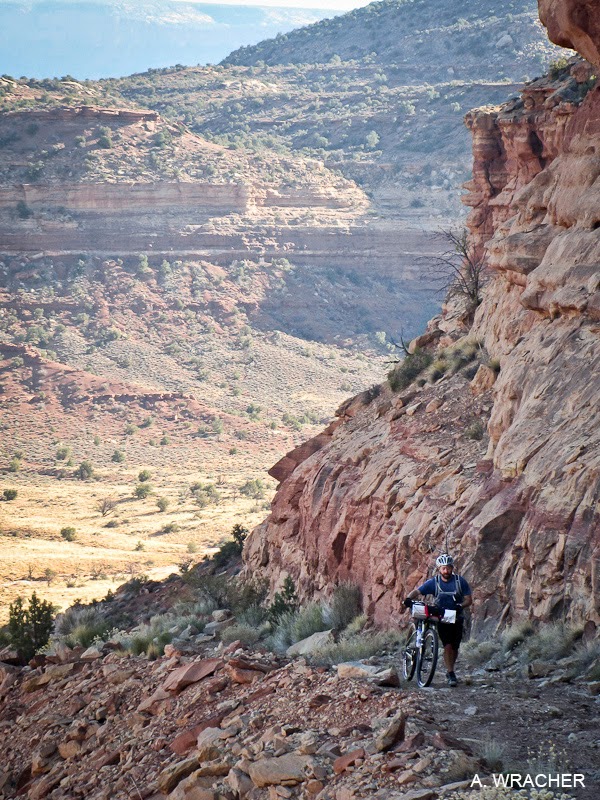
Exploring the White Canyon complex in southeast Utah

Andrew Wracher is an avid cyclist and camping enthusiast living in Durango, CO.  A couple of years back his love of the outdoors and bikepacking led him to start designing and handmaking his own frame and bike packs. He calls his business Bedrock Bags. Earlier this year he became the owner of a 2014 Soma B-Side, our 650b hardtail frame.

What kind of cycling do you enjoy most?
I enjoy bikepacking in and around the Four Corners, as well as riding local singletrack around Durango during the workdays.

For the folks who might not know, what is "Bikepacking"?
Bikepacking is a unique form of bicycle touring that typically relies on rackless pack systems to travel lighter than traditional bicycle touring. Traveling without traditional racks and panniers allows the rider the option of traveling on rough terrain such as mountain single track or rough four wheel drive roads. Bikepacking can range from a recreational overnight to a 500 mile race on the Colorado Trail.

 
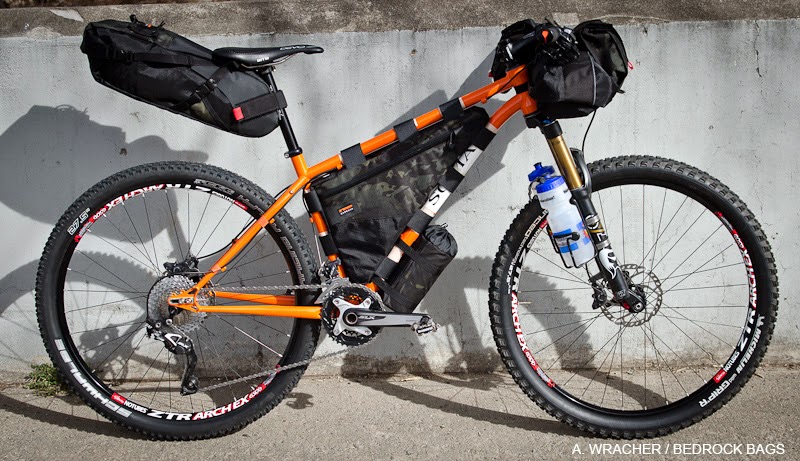
Andrew's B-Side frame does have rack eyelets, but in bikepacking
participants usually forgo conventional racks. Build highlights: 120mm travel
Fox fork, Stan's No Tubes wheels. Michelins in front, Schwalbes in back.

Great shot! See more of Andrew's
photos on Flickr.
You seem like an individual that can't get enough of the great outdoors. Why is that/where does that come from? What other outdoor activities are you passionate about.
I started backpacking at a very young age with my family. Since then being outdoors has become a way of life. It's just something I need. Canoeing, fishing, kayaking, rafting, cycling, backpacking, surfing...It's all a way to interact with and explore the world we live in. It doesn't get much more complicated than that.

What do you like about your Soma B-Side?
For bikepacking I wanted the ability to run adjustable dropouts in case the derailleur failed. If I'm stuck in the middle of nowhere with a broken derailleur I can run a single speed setup to get home. I also wanted wheels that would roll efficiently while maintaining stiffness. 650b (compared to a 29er) allows for greater clearance between the rear wheel and seat as well as a slightly larger main triangle. This is important for making room for bikepacking bags. The B-side is a great bikepacking platform. 
For my backyard single track I wanted a bike that could turn on a dime and manual off a drop with out feeling like a tobaggon. Short chain stays and fun geometry really make this bike a blast. Efficient, fun, flickable, steel, trustworthy. What else do you need?
What kind of research do you do come up with your designs?  
At first I just looked at what everyone else was doing. Lately I rely on my own experiences in addition to input from some seriously talented cyclists that are at the top of their game. To be honest, the feedback from these folks is invaluable. Almost daily some small detail of one of my bags is tweaked or refined to improve the product. 

I love providing people with the gear they need to explore places they have never been to. My part is small, what people do with it is incredible. I don't have a big fancy job, but if people can do great things with something I have made...well, that feels pretty good.


Do you have a background in sewing or industrial design? You didn't just wake one day and found you had a talent to make bikepacking bags, did you?
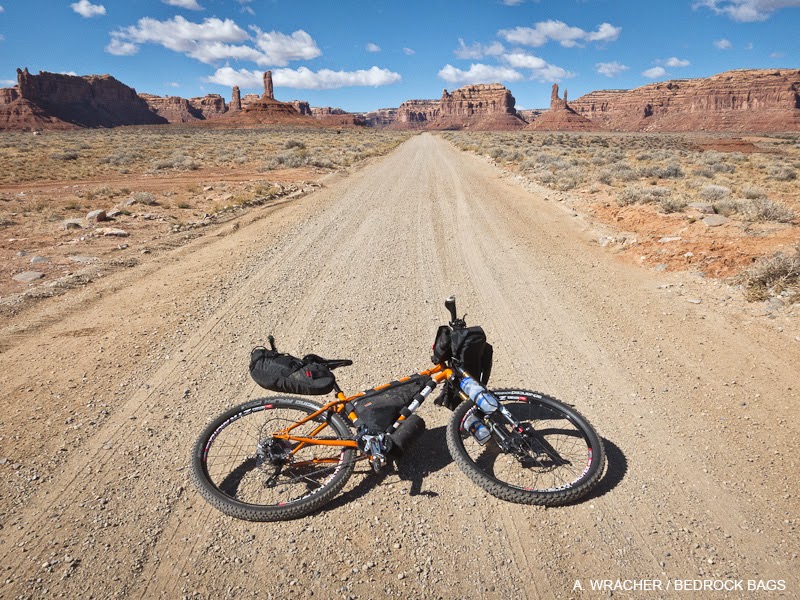
Open road in the Valley of the Gods, Utah
I have been sewing outdoor gear for my own needs for the last ten years. When I think of a new design I can see it in three dimensions. I can literally spin it around in my brain like I'm watching a video. One day I made a set of bags because I wanted to give bikepacking a shot and they worked out alright. I showed them to a friend who was the new owner of a bike shop (Velorution Cycles) and the rest is history.

What is your most sought after creation currently?
 At this point it is a tie between the Entrada Handlebar bag and custom frame bags.

[Soma did not provide a B-Side for his review. Andrew did not provide us any free bags to wrangle an interview, though we wouldn't refuse one if he offered. We are totally grateful to Andrew for the interview and sharing his photos.]

Friday, August 17, 2012

Pushing The Pedals (In Cuba)

Yes. The guy is carrying a cake while gravel grinding it to some customer's home.
The photographer followed him for over a mile and  he never faltered.
I smell a possible race event idea.
Happy Friday everyone. Just wanted to share an up and coming bicycle blog. I met Daniel, the writer, when he was working at American Cyclery in S.F. He is now in the Czech Republic of all places. Most of his articles are regarding touring or bike camping.

One of his latest posts was guest penned by his girlfriend. She went to Cuba, a place I have always been interested in checking out. Here are a couple of photos. Visit Pushing the Pedals to read more.

Monday, October 12, 2009

Cyclo-touring and bags

Fall in the Bay Area is one of the best times of year. We will often have some of our best and most consistent weather throughout September and October. We may have a storm blowin' in tomorrow, but this past weekend was perfect for a little weekend in the woods.

We loaded up and rolled out Saturday morning. One night in the woods, especially at a camp only 5 miles from a relatively populated area (Marin) means you can get away with being a little haphazard with your planning and setup, but it also means you can get up and decide to head out for the weekend on a whim. Our trip was somewhere in between, and it was great to roll out of bed, get a coffee and turn the pedals all day while taking in the scenery. I think it was the polar opposite of training for 'cross, which has been about all the riding I have been doing as of late.


Some happy folks rolling along Crissy Field.


The lineup.


China Camp in San Rafael is an awesome campground and trail network with beautiful oaks and salt marshes.


Brats, Knocks, Soy-Beer Brats, squash and onions. Look at the perfect grill marks. Jesse's grilling is the business.


Post-camping I set off to do my weekly shopping with my new gear tote. It is the Sackville Shopsack from Rivendell, which is made in the USA of fine Scottish fabric in an awesome olive green. If you have used the cheapo bags they sell at the counter of grocery stores you know how they last all of a few months. This bag is stout, classy, and will last decades instead of months. This is the bigger size of the two (they are sized to fit the Wald 137 and 139 baskets) and easily holds a large baguette and all kinds of junk food, which, from looking at that photo, is apparently what I eat.


Bungee'd to a rear rack is not nearly as class as in a Wald basket, but it does the trick.