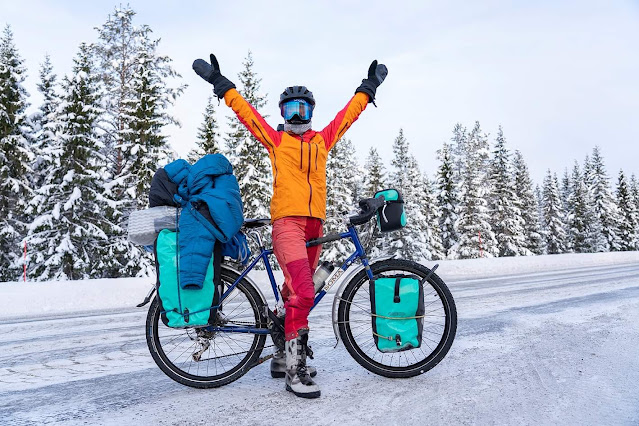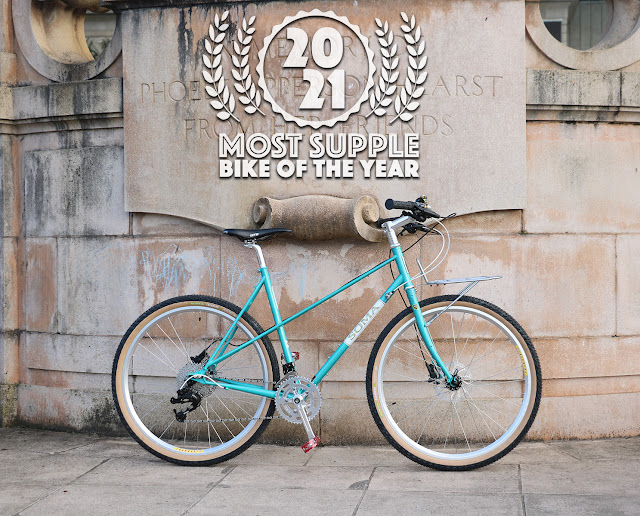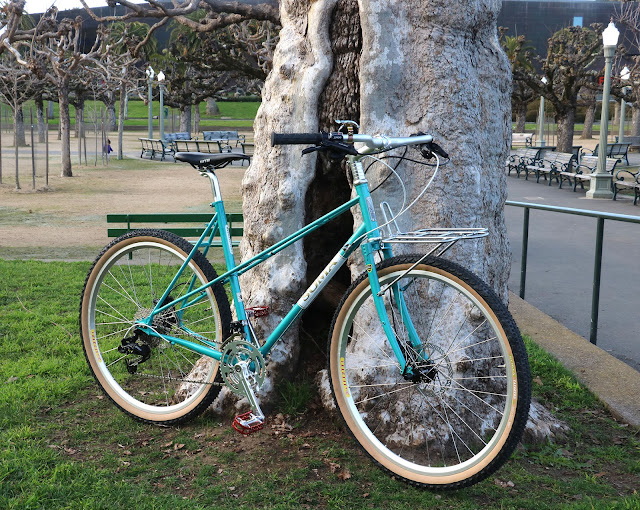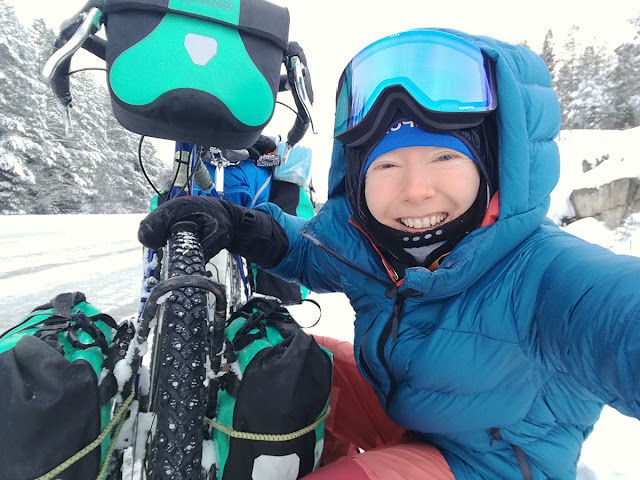
Teresie Hommersand grew up near Stavanger, a city known as the oil capital of Norway. She remembers eating supper every evening off plates with the logo of the national oil and gas company on them. Somehow she became the "green sheep" of the family. She has lived in Uganda, Oregon, and Australia. Learn more about her 13,700 km ride going from the most southern part of South Africa to the northernmost part of Norway (Capetown, South Africa to Kapp, Norway) and her charity crowdfunding campaign on her Facebook page and Instagram. She is currently nearing the end of her journey - in Norway above the Arctic Circle. She has been riding a Soma Saga for the entire adventure.
Your mode of transportation affects what you experience - as do the seasons while riding. Especially in a country like Norway with big seasonal differences. I thought I knew what cold was, but cycling into winter, en route from the most southern point of Africa to the most northern point in Europe on my Soma Saga, I quickly understood that I didn't.
When cycling across continents over time, you cannot always have blue skies and pleasant summer temperatures. 'Thank God' by the way! How boring wouldn't that be? When my friends saw that I was going to most likely hit Norway mid-winter, I was told to speed up, so I'd avoid cycling in winter. Warnings telling me how absolutely horrible the experiences of others had been. I'm so glad I didn't. Cycling and camping in full-on winter conditions is a challenge, but also a definite highlight on this journey!
I'm so thankful for pretty much living outdoors en route. In my tent. Seeing and feeling the seasons gradually and subtly changing. Something I've never been in tune with before, living inside of four walls. It's fascinating, seeing the first thin ice at the edges of a small stream when refilling my water bottle. The shapes, colours and textures make it look like art. As do icicles next to the road. The excitement at the first frost on my tent. On my bike. Discovered when getting out of my tent in the morning. It was getting cold for sure, but I was still managing with the gear I had.
Re-thinking My Equipment Strategy
Then, while staying with simply amazing people for a few nights, it suddenly got cold. Bone-chilling cold! From -5°C to -15. -20°C. Born and raised in Norway I though I knew what cold was. But there I was, for the first time truly understanding that the winter temperatures along the southwest coast of Norway is hardly comparable to that of the further north inland areas. This was serious. Dead serious. I realized I wasn't equipped to continue cycling without putting my life at risk.
A few nights turned into a few weeks under the roof of Randi and Svein Helge, getting all the needed gear together. I'm still feeling so grateful thinking of them and how they helped me out in the biggest way - and included me in their lives. As I was about to hop on my bike again, Randi asked me what places en route I've stayed longer than a few days. To the relatively short list that includes Nairobi, Khartoum, Amman, Jerusalem, Istanbul, Athens, Vienna and Berlin, I now have to add Høylandet. A random tiny village in Norway. We had to laugh as we hugged goodbye.
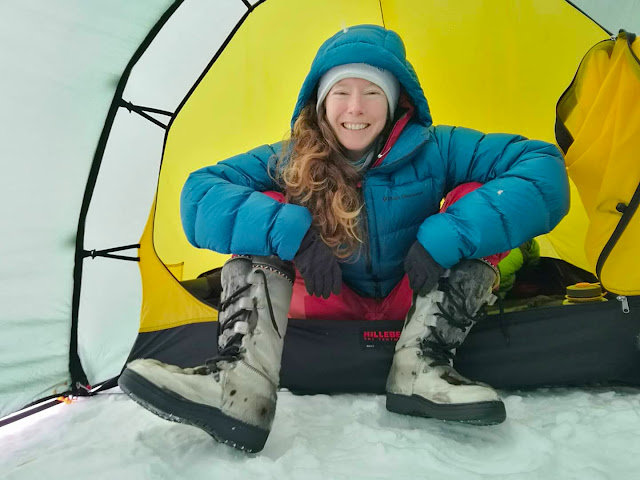
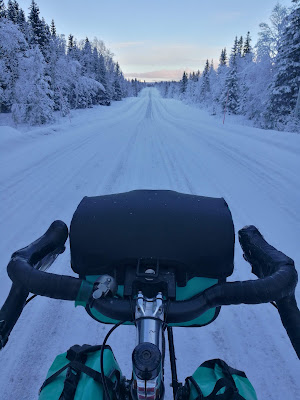
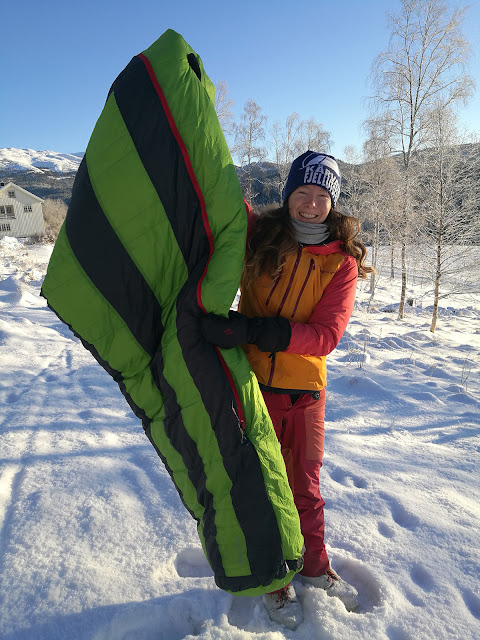
Now the real adventure began! Every single piece of sponsored winter equipment was allowing me to not just survive but enjoy touring in winter! It's absolutely fascinating and amazing how one can keep warm with right equipment and enjoy - even though it's down to -30°C! I cannot think of much else that is as beautiful as a winter landscape - and riding through it. It's like a white desert. Silent. Vast. Muffled sounds. Snow crystals on my handlebar pannier. Crisp air. Low hanging branches under the weight of snow. And the light. Pastel colours at dusk. Pink. Purple. Now my favourite time of the day. You don't get light like this other times of the year. Waking up in winter wonder land. Emerging from my heavy duty winter sleeping bag. Peeping out of my tent each morning, I got a huge smile on my face that stayed there the whole day. So happy!
Three Hours to Set Up Camp?
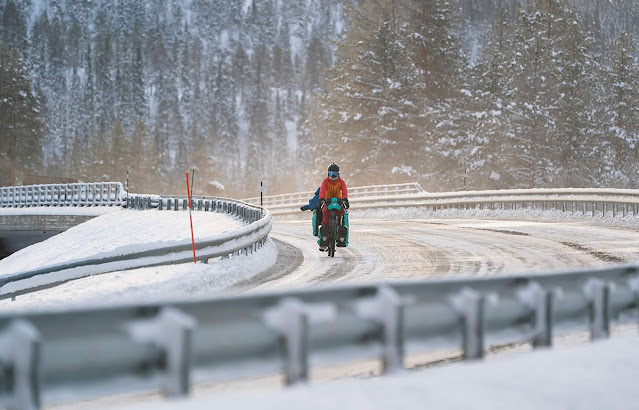
And happy I was managing and thriving in my new circumstances. Cycling and camping in the snow and hefty minus degrees. A first for me and a real sense of achievement. But it does require a lot more work. Everything takes more time and goes slower. I am cycling on snowy and icy roads with an extra weighed-down bicycle due to all the must-have winter equipment. My winter sleeping bag alone was filling up one of my rear panniers. Also taking up more time was setting up and taking down camp. Before I hit winter I was using my light weight MSR Hubba NX solo tent. Self-standing and so easy and quick to put up. 10 minutes. For winter I exchanged it for Hilleberg's robust Nallo 2 sleeper, allowing me to fit all the extra gear and cook inside the large vestibule in case of bad weather. But putting up and taking down this tunnel tent was an exercise in patience. From the time I stepped off my bike until I was ready to hit the sack, it usually took around three hours. Three hours!
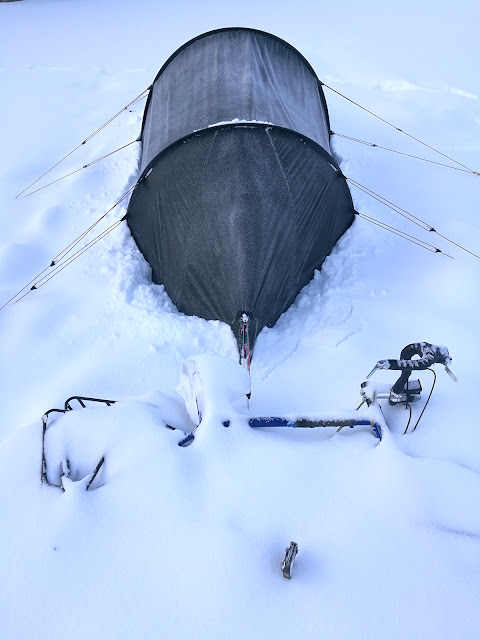
I couldn't push my bike through the snow, it was too deep, so I had to take off all the stuff on my bike and take turns carrying it from the road over to my chosen camping spot. Then push my bike through the snow. Before erecting the tent I had to stomp the ground, making it flat and leveled. Since I didn't carry skis, I had to do it literally one step at a time. Other times I had to dig or shovel snow to make it nice. When putting up the tent, because the ground is frozen, I couldn't use normal pegs, but snow pegs. Fastening them also requires digging and snow shoveling, and there was 10 of them. The tent is very sturdy afterwards though. Then I had to unpack all my stuff. Cook. Melt water. Make a hot water bottle. None which I have to do other times of the year. I can eat cold food and get water from a stream.
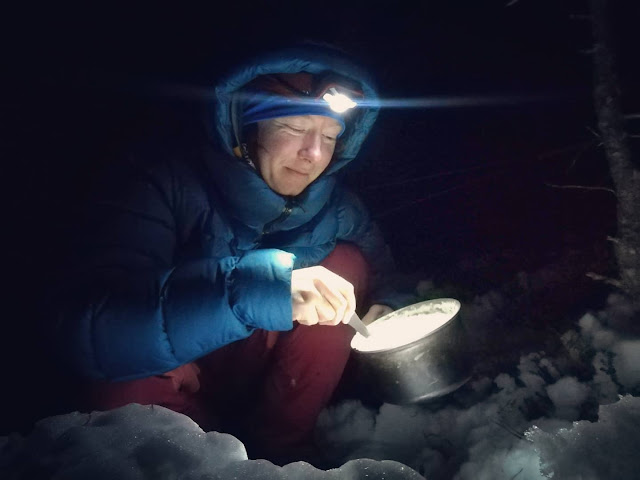
I addition, the number of daylight hours this far north in winter are few. Perhaps the greatest challenge for me riding in winter is to stay motivated when you're average distance per day is only 30 kilometers and you feel like more than half of the time all you're doing is putting up and down your tent.
Still Rewarding
But despite all this extra work and occasionally cold toes and fingers, it's so worth it. And because it is a challenge, it's even more exciting and rewarding. I'm feeling so grateful for getting to experience all climates and seasons on my bike. From riding in 50°C in Sahara in Sudan, to riding in -30°C in winter in Norway. I'm now doing my second winter on my Soma Saga, this time above the Arctic Circle. This time in even more darkness. But I wouldn't have it any other way.